Showing posts with label technology. Show all posts

Friday, July 20, 2012

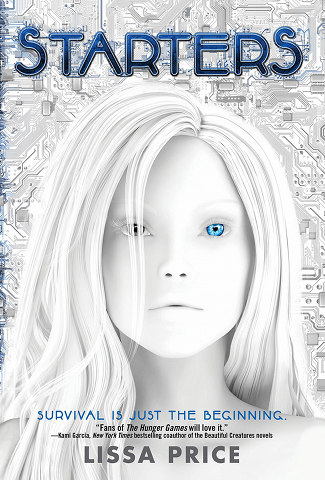
Starters Book Review

 Author: Lissa Price. Release date: 2012. Publisher:  Delacorte Books for Young Readers. ISBN: 9780385742375.

Annotation: It’s been a year since sixteen-year-old Callie and her seven-year-old brother Tyler lost their parents in the Spore Wars. Now, living on the streets with their former neighbor Michael, Callie learns of Prime Destinations: a company that pays teens to let their bodies be rented by seniors who, through a chip implanted in their brains, can live inside the teen and be young again. Callie wants the money the company can offer, but is it worth it to let a stranger rent her body?
Personal thoughts: I am always a fan of a good dystopian novel, and this one was truly enjoyable! The book is very creative and well-written, combining some ideas I’ve read before with some new ones to make for a fresh story. I really liked Callie and am looking forward to seeing where the author takes her as the series plays out. I also found the support characters to have a lot of depth as well, something that adds to the strength of the novel. I can’t wait for Enders to find out what happens next! I would definitely recommend this series easily to a teen reader.
Plot summary: After the Spore Wars took the lives of her parents, sixteen-year-old Callie Woodland and her seven-year-old brother Tyler were forced to flee their home for a life on the streets of Los Angeles. Since the only members of the population who were able to receive vaccinations against the biological bombs were children and the elderly, North America has been reduced to Starters, teens twenty and under, and Enders, seniors eighty years and older. Unclaimed minors, those without grandparents or other living relatives to be their guardians, live in abandoned buildings and survive off scraps, anything to avoid capture and imprisonment in one of the state run institutions for orphans. Callie and Tyler, along with their friend Michael, have survived for a year on the streets, but just barely. Tyler has a medical condition, and Callie isn’t sure how much longer he can live off of food found in garbage cans and water stolen from drain pipes. Everything changes, however, when Callie hears about a company called Prime Destinations. Since modern medicine has allowed the Enders to live well into their 100s, many are seeking ways to recapture their youth. Prime offers wealthy Enders the chance to rent the body of a teen donor, who, for a hefty payment, allows the company to implant a microchip that allows the renter to live in them while the actual mind of teen enters a sleeplike state. Callie is concerned by the thought of some 150 year old Ender woman controlling her, but the money she would earn could get her, Tyler, and Michael a home, food, and medicine for years. Should Callie donate her body to Prime Destinations for the chance to give her brother a better life?
Review: The sea of young adult literature has recently been swarmed with dystopian novels, some better than others. Starters, the first installment in a new series by Lissa Price, is, fortunately, one of the better ones! Set in the not-so-distant future following a catastrophic war, Callie Woodland’s world is divided. At one end are the Starters, teens and children who were able to get vaccinated against the biological weapons. At the other are the Enders, seniors who were also vaccinated and survived the war. For those teens and children who survived and were lucky enough to have a wealthy, living grandparent or other Ender relative, life is good. For those who lost their parents and had no one else to claim them, however, life is very much survival of the fittest. Many elements of this story are reminiscent of The Hunger Games: Callie is a strong female figure who provides for her younger sibling, there is a harsh police force that Callie must outwit, and there are those who live a lavish lifestyle, oblivious to the plight of the unclaimed Starters. For these reasons, but also because it is simply a good story, fans of The Hunger Games might find just the series they are looking for to continue in the vein of Suzanne Collins’ trilogy. One thing about Starters that differs from The Hunger Games, however, is that there is considerably less romance in Lissa Price’s story. There is a bit of a love triangle, but Callie spends most of her time trying to provide for her brother rather than choosing which boy to end up with. Overall, this is a very enjoyable start to a series that readers, both teen and adult, are sure to love. The sequel, Enders, is set to be released December 11, 2012.
Genre:  Science-Fiction
Reading level: Grade 7+
Similar titles: The Hunger Games series by Suzanne Collins, A Long, Long Sleep by Anna Sheehan, Divergent series by Veronica Roth, Eve by Anna Carey, Legend by Marie Lu, The Pledge by Kimberly Derting.  
Themes:  Dystopian, war, plague, orphans, technology, conspiracy.
Awards/Reviews:  Positive reviews from Los Angeles Times, Booklist, Kirkus, and Publishers Weekly.  
Series Information: First installment in Starters and Enders series. Second novel, Enders, set to be released December 11, 2012.  
Discussion questions:
-     Do you think something like the Spore Wars is possible in the near future? Why or why not?

-     Why do you think only Starters and Enders were vaccinated? Do you think that was a mistake? Why?

-      If you were Callie, would you donate your body to Prime Destinations? Why or why not?

-       Did you agree with Helena’s plan?

-       What would you like to see happen in the sequel?


Sunday, December 18, 2011

Unison Spark Book Review

Author: Andy Marino. Release date: 2011. Publisher:  Henry Holt and Co. ISBN: 9780805092936.
Unison Spark
Annotation:  Mistletoe and Ambrose are two fifteen-year-olds living very different lives in a futuristic world obsessed with Unison: an all-consuming, virtual reality social network. Suddenly, their two lives intersect and they realize that their shared past might be the key to the future of Unison.
Personal thoughts:  I really love the concept of the all-consuming social network and so I really wanted to love this novel. Unfortunately, I found it to be too confusing and the characters too under-developed for me to really enjoy it. There were definitely some highpoints in the story (I thought the topside/sub-canopy idea to be interesting and the descriptions of holo-fashion and life in Unison), but I just could not get into the book. One of my biggest problems was that I didn’t like Mistletoe at all, but there was no one else in the story for me to really latch onto as my preferred character. That being said, however, I do think that Andy Marino has some really great ideas that I would love to see flushed out more in future novels. I would definitely be interested in picking up his next book to see what it’s like!
Plot summary: In the futuristic town of Eastern Seaboard City, society is divided into the canopy and sub-canopy zones, separated by a steel barrier that keeps the rich and poor from intermingling. Fifteen-year-old Mistletoe lives in the sub-canopy with her guardian, Jiri, dreaming of what life must be like topside for those who can afford to be a part of Unison. Described as the great-great-grandchild of Facebook or Myspace, Unison is a virtual reality social network that most people living above the canopy spend their lives logged into, their “fleshbound” existence no longer important. Ambrose Truax, the fifteen-year-old son and heir of Unison’s creator, Martin Truax, spends his life helping his father and brother, Len, manage Unison. Mistletoe and Ambrose are about to cross paths, however, when a mysterious message transferred to Ambrose against his will warns him that his life is a lie and that his father cannot be trusted. Longing for the truth, Ambrose leaves his privileged life topside and ventures down into the sub-canopy city of Little Saigon. After saving him from a run-in with police intent on returning him to his father, Mistletoe and Ambrose discover that they have something startling in common: a shared nightmare of a stark lab and grisly wires. What is the connection between Mistletoe and Ambrose, and how will the truths they eventually uncover affect the future of Unison?
Review:  This debut novel from author Andy Marino weaves an interesting but often overly complicated tale that, unfortunately, makes for a confusing read. The overall concept and setting of the novel is, by far, Marino’s biggest achievement. The topic of extreme social-networking is something that has been featured more and more in popular culture in recent years, particularly through movies like Gamer and Surrogates. Readers who are familiar with these films will undoubtedly see plot similarities: the idea of people ceasing to exist in their physical lives and instead being only digital projections, the ability to form a new identity online that is completely different from reality. Marino adds new elements to these concepts by including things like status updates, friend requests, event invites, and other Facebook-ish terms that readers, especially teens, will be able to identify with. The society in which Unison exists is also interesting, with the topside/sub-canopy distinction, holo-fashion and atmoscrapers. Where the novel falls flat, however, is in character development. Mistletoe and Ambrose are the two most flushed out personalities in the story, but are still difficult to side with because the reader knows so little about them. Other, more promising characters are introduced but given no opportunity for development. The result is a plot that is full of twists, turns, and complexities but is unable to engage the reader, leaving them, instead, confused. It is clear that author Andy Marino has many interesting ideas, however, and hopefully, in upcoming novels, improvements will lead to more enjoyable and engaging stories.  
Genre: Science-Fiction
Reading level: Grade 8+
Similar titles: Little Brother by Cory Doctorow.
Themes:  Social networking, technology, dystopian, virtual reality.  
Awards/Reviews:  Positive reviews from Booklist and Publishers Weekly.   
Series Information: N/A   
Discussion questions: 
- Do you think that a program like Unison is the future of Facebook or Myspace? Why or why not?
-  If you lived in Eastern Seaboard City, would you want a Unison account? Why or why not?
- How do you think social networking currently influences the way people interact in person? How do you think that will change in the future?
- Why do you think the corpses were left on display in the airlock between the sub-canopy and topside zones?
- Explain your interpretation of the novel’s conclusion.

Monday, June 27, 2011

Awaken Book Review

Author: Katie Kacvinsky. Release date: 2011. Publisher:  Houghton Mifflin. ISBN: 9780547371481.
Annotation:  Seventeen-year-old Madeline Freeman lives in a world that is kept in a state of perpetual safety and peace. Everything is wired: school is digital, relationships, activities, everything is done by computer from home. But when she starts to see that this life is missing something, she must choose between being safe and really living.  
Personal thoughts:  I really enjoyed this book and read through it very quickly! It definitely makes a statement about how wired we are in today’s society and the slippery slope that lies ahead. As an former-Oregonian, I did find Kacvinsky’s use of Corvallis as a bustling metropolis of the future kind of funny. Other than that, the story was very interesting and well written. According to her website, she plans to write a sequel, Middle Ground, coming soon. I look forward to it!
Plot summary: The year is 2060, and seventeen-year-old Madeline “Maddie” Freeman lives a very sheltered digital life. In Madeline’s society, everything is done online from home. Children are educated through Digital School, a program created by Maddie’s father, and very little face-to-face interaction occurs anymore. Maddie has come to terms with her digital life, but this hasn’t always been the case. When she was fifteen, Maddie hacked into her father’s computer, releasing important information to those opposed to Digital School. This serious crime could have landed Maddie in a detention center for life, but her father’s influence saved her, and now she lives in a state of house arrest: her actions are monitored, websites she can visit controlled, and she is not allowed to socialize with anyone in person. Everything changes, however, when Maddie meets an online friend in person for the first time. His name is Justin, and Maddie quickly learns that he is one of the rebels opposed to Digital School that she helped in the past. Justin tries to convince Maddie that her digital life isn’t reality and that he and the rest of the rebels need her help. But can Maddie really turn on her family, even if she is opposed to her father’s creation?
Review:  This debut novel from author Katie Kacvinsky is a thrilling combination of technology, adventure and romance in an interesting futuristic setting. The society in Maddie’s 2060 is very conceivable given the current trends of our reliance on computers. Far more social interaction is done online in 2011 than ever before, and the complete shutting out of face-to-face relationships in favor of the safety of the computer screen doesn’t seem so improbable. Perhaps one of the best parts of Awaken is that it will likely shed light on these issues for teen readers who might be overly caught up in their Facebook, text messaging or online games. Apart from this hard look in the mirror, Kacvinsky has crafted an intriguing plot and set of characters that will surely make for a good series. Maddie is a very likable protagonist and her strained romance with Justin will likely remain at the forefront of the story in the next installments. The futuristic technology Kacvinsky creates, cars that can go underwater as submarines, lipstick-sized stun guns, add to the fun. A good start to a promising series.
Genre: Fiction/Adventure
Reading level: Grade 7+

Similar titles: Little Brother by Cory Doctorow, Divergent by Veronica Roth and The Giver by Lois Lowry.
Themes:  Technology, relationships, in-person vs. online interactions, romance, rebellion.   
Awards/Reviews:  N/A  
Series Information: Sequel Middle Ground coming soon.

Discussion Questions:

- Do you think that Digital School could actually become a reality? Why or why not?

- Why do you think that Maddie is against digital school? Would you feel the same way she does? Why or why not?

- Do you think that Maddie and Justin should try to have a romantic relationship? Why or why not?

- Why do you think Maddie's father wants to protect Digital School so much?

Monday, May 16, 2011

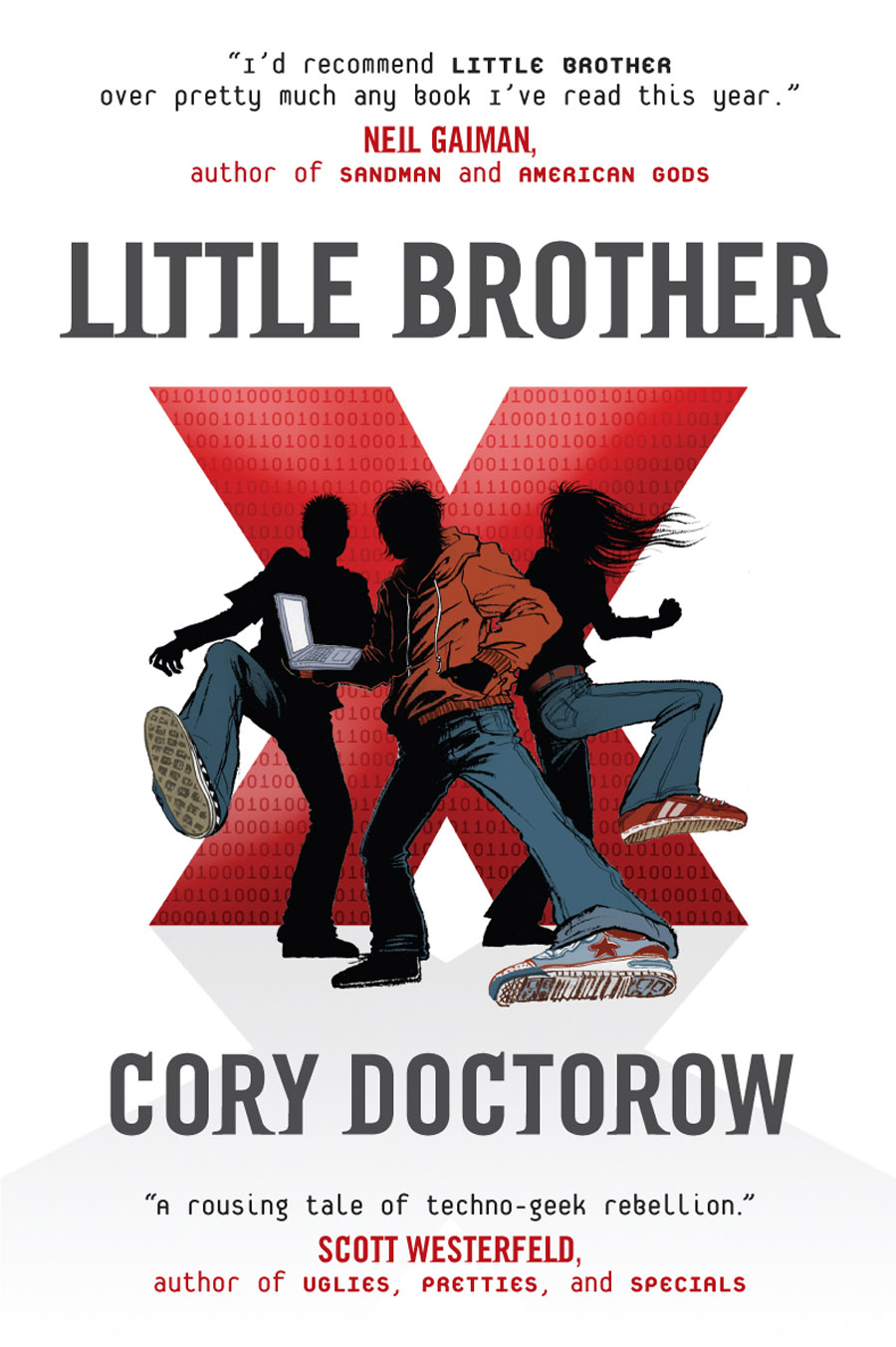
Little Brother Book Review

Release date: 2008. Author: Cory Doctorow. Publisher: Tor Teen. ISBN: 978-0765323118.


Annotation: After being caught in the wrong place at the wrong time, Marcus Yallow, high school senior and computer whiz, launches a cyber war against the corrupt Department of Homeland Security that brutally interrogated him and his best friends following a terrorist attack.


Personal thoughts: This thought-provoking novel, though a little far-fetched, is still an enjoyable read for teens. It has a huge technology component that many readers will enjoy, and the San Francisco bay area setting is very interesting as well. The novel will definitely resonate with budding conspiracy theorists as well.

Plot summary: Tech-savvy, gamer Marcus Yallow is a high school senior in a San Francisco of the very near future. Constantly trying to evade his school's many security systems to play hooky, Marcus with his three best friends, Darryl, Vanessa (Van) and Jose Luis (Jolu), spends his time playing alternatate reality games and jaunting around his beloved city streets. One ordinary day, however, Marcus, Darryl, Van and Jolu get caught up in the aftermath of the worst terrorist attack in US history, and are taken into custody by the Department of Homeland Security (DHS). After being brutally interrogated, Marcus, Van and Jolu are released from prison and warned to never speak of their experiences as prisoners of the DHS. The return to their lives in San Francisco, only to find that the city is now overrun by menacing security precautions implemented by the DHS. Determined to expose the crimes committed by the DHS and thwart their efforts to "prevent future terrorist attacks," Marcus begins an all-out cyber war on the corrupt government agency. Using his computer hacking skills, new found love interest, Ange, and an army of high school students, Marcus delves deeper and deeper into his web of revenge. Will he be able to win this war, or will the government maintain its vice grip on lives of its citizens?

Review: Full to the brim with techno jargon, pop culture references, and "leet," Cory Doctorow's Little Brother is an entertaining, if somewhat far-fetched, story about how far governments can and should go to keep their citizens safe. The story is told in the first person by Marcus Yallow, high school senior and generally cocky computer hacker, who involuntarily becomes involed with the Department of Homeland Security (DHS) after a large-scale terrorist attack on his beloved San Francisco. Bay area residents will appreciate Marcus' references to San Francisco streets and neighborhoods, and Doctorow's descriptions of the city are clever to the point that it almost becomes as important a character as Marcus himself. Equally as compelling are Doctorow's detailed descriptions of the methods Marcus uses to thwart the DHS, making the novel almost a lesson in computer technology and security systems. By the end of the story, the reader will have a clear understanding of "arphids," "gait tracking software," "Linux," and much more. Apart from the obvious mischief and havoc Marcus causes by exploiting his computer skills, the novel also acts as a critical examination of the application of these technologies in monitoring the behaviors of American citizens. Even before the terrorist attacks, it is clear that the world Marcus lives in is one of heavy surveillance. Using the experiences of his characters, Doctorow shows a very possible future of security taken to the extreme. Overall, the novel is a very relevant and thought-provoking read for teens and adults alike.


Genre: Fiction
Reading level: Grade 8+

Similar titles: N/A

 
Themes: Conspiracy, terrorism, technology.


Awards/reviews:
New York Times bestseller for six weeks
Winner of 2009 White Pine Award
Winner of 2009 Prometheus Award
Winner of 2009 John W. Campbell Memorial Award
Finalist for Hugo Award for Best Novel

Series information: N/A


Discussion Questions:

- After reading this novel, do you think the author has a positive or negative opinion of technology? Why?

- Do you agree with the stance taken by Homeland Security after the terrorist attack? Does it remind you of any precautions that you've seen taken to prevent violence?

- Do you think the future in "Little Brother" could happen? Why or why not?

- Who was your favorite character in the novel?

- Did you like San Francisco as the setting for the story? Do you think the story could have worked in another major city? Which one?