Monday, May 16, 2011

Life in the Fat Lane Book Review

Release date: 1998. Author: Cherie Bennett. Publisher: Dell Laurel-Leaf. ISBN: 0440220297.
Annotation: Lara Ardeche is perfect; thin, beautiful and popular she is a lifelong pageant winner and recently elected homecoming queen. Lara's life changes forever, however, as she rapidly and inexplicably gains weight


Personal thoughts: I enjoyed this novel quite a bit because it took a different perspective on a common topic: dealing with obesity in high school. Instead of having spent her life overweight, Lara Ardeche transitions from beautiful and perfect to living "in the fat lane." I thought this was interesting, and I'm sure will resonate with readers who have experienced weight fluctuations.


Plot summary: Junior in high school, Lara Ardeche, has the perfect life. Beautiful, popular and thin, Lara has spent her life competing in and winning beauty pageants. Her beautiful, thin mother and handsome father adore her, as does her cool boyfriend Jett and her best friend, Molly. Lara's life becomes even better when she is elected homecoming queen, despite the fact that she's just a junior. In the months following her homecoming victory, however, Lara's life becomes a living hell as she inexplicably begins to gain weight very rapidly. As she grows bigger and bigger, her popular friends abandon her, and Lara tries everything to get back to her former thin self. Matters are only worsened by her "perfect" parents who constantly pressure her to diet. After rigorous medical testing, Lara finally discovers that a rare metabolic disorder is the cause of her weight gain, a disorder for which there is no cure. As Lara's life continues to fall apart, she discovers that perhaps things were not as perfect as she had imagined, even when she was thin.


Review: Life in the Fat Lane provides a unique view of the teenage obsession with appearance as Lara Ardeche experiences both sides of the coin. Beginning the novel as a thin, beautiful and popular homecoming queen, the reader sees the benefits of fitting in with society's ideal image. As Lara gains weight rapidly, eventually ending up a size 24, the emotional torment she experiences illustrates the loneliness of being "different." As the reader transitions with Lara from beauty queen to "freak," Bennett takes the audience on the heartbreaking journey with her character. Secondary to Lara's weight disorder but equally heartbreaking is the breakdown of Lara's parents' marriage. Lara's mother provides a clear image of the future Lara may have had as a thin, beautiful woman, particularly the fact that this future is far from perfect. Overall, Life in the Fat Lane is a realistic look at what happens when the lie of perfection fails, and how to overcome the realization that apperances aren't everything.

Genre: Fiction

Reading level: Grade 7+

Similar titles: N/A

Themes: Eating disorders, popularity and image, divorce, weigh gain and loss, parental pressure.

Awards/reviews: Positive reviews from Publisher's Weekly and School Library Journal. Winner of ALA's Best Book for Young Adults award 1999.

Series information: N/A


Discussion Questions:

- Do you think how much a person weighs is important? Do you think other people think it's important? Why or why not?

- How do you think Lara's life changes once she becomes "fat"?

- Would you ever make fun of someone for being "fat"?

- Do you think Lara's life was easier when she was thin?


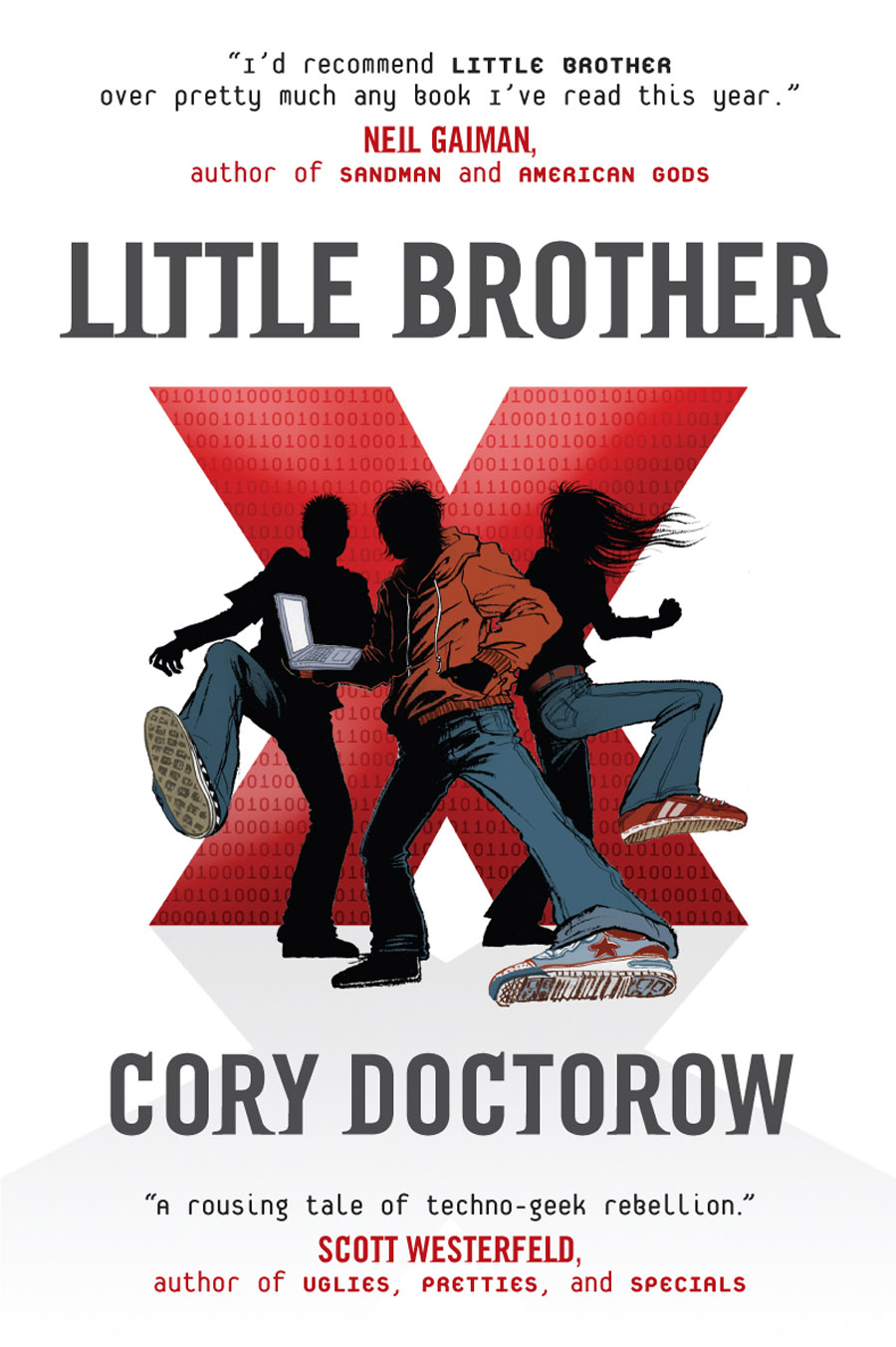
Little Brother Book Review

Release date: 2008. Author: Cory Doctorow. Publisher: Tor Teen. ISBN: 978-0765323118.


Annotation: After being caught in the wrong place at the wrong time, Marcus Yallow, high school senior and computer whiz, launches a cyber war against the corrupt Department of Homeland Security that brutally interrogated him and his best friends following a terrorist attack.


Personal thoughts: This thought-provoking novel, though a little far-fetched, is still an enjoyable read for teens. It has a huge technology component that many readers will enjoy, and the San Francisco bay area setting is very interesting as well. The novel will definitely resonate with budding conspiracy theorists as well.

Plot summary: Tech-savvy, gamer Marcus Yallow is a high school senior in a San Francisco of the very near future. Constantly trying to evade his school's many security systems to play hooky, Marcus with his three best friends, Darryl, Vanessa (Van) and Jose Luis (Jolu), spends his time playing alternatate reality games and jaunting around his beloved city streets. One ordinary day, however, Marcus, Darryl, Van and Jolu get caught up in the aftermath of the worst terrorist attack in US history, and are taken into custody by the Department of Homeland Security (DHS). After being brutally interrogated, Marcus, Van and Jolu are released from prison and warned to never speak of their experiences as prisoners of the DHS. The return to their lives in San Francisco, only to find that the city is now overrun by menacing security precautions implemented by the DHS. Determined to expose the crimes committed by the DHS and thwart their efforts to "prevent future terrorist attacks," Marcus begins an all-out cyber war on the corrupt government agency. Using his computer hacking skills, new found love interest, Ange, and an army of high school students, Marcus delves deeper and deeper into his web of revenge. Will he be able to win this war, or will the government maintain its vice grip on lives of its citizens?

Review: Full to the brim with techno jargon, pop culture references, and "leet," Cory Doctorow's Little Brother is an entertaining, if somewhat far-fetched, story about how far governments can and should go to keep their citizens safe. The story is told in the first person by Marcus Yallow, high school senior and generally cocky computer hacker, who involuntarily becomes involed with the Department of Homeland Security (DHS) after a large-scale terrorist attack on his beloved San Francisco. Bay area residents will appreciate Marcus' references to San Francisco streets and neighborhoods, and Doctorow's descriptions of the city are clever to the point that it almost becomes as important a character as Marcus himself. Equally as compelling are Doctorow's detailed descriptions of the methods Marcus uses to thwart the DHS, making the novel almost a lesson in computer technology and security systems. By the end of the story, the reader will have a clear understanding of "arphids," "gait tracking software," "Linux," and much more. Apart from the obvious mischief and havoc Marcus causes by exploiting his computer skills, the novel also acts as a critical examination of the application of these technologies in monitoring the behaviors of American citizens. Even before the terrorist attacks, it is clear that the world Marcus lives in is one of heavy surveillance. Using the experiences of his characters, Doctorow shows a very possible future of security taken to the extreme. Overall, the novel is a very relevant and thought-provoking read for teens and adults alike.


Genre: Fiction
Reading level: Grade 8+

Similar titles: N/A

 
Themes: Conspiracy, terrorism, technology.


Awards/reviews:
New York Times bestseller for six weeks
Winner of 2009 White Pine Award
Winner of 2009 Prometheus Award
Winner of 2009 John W. Campbell Memorial Award
Finalist for Hugo Award for Best Novel

Series information: N/A


Discussion Questions:

- After reading this novel, do you think the author has a positive or negative opinion of technology? Why?

- Do you agree with the stance taken by Homeland Security after the terrorist attack? Does it remind you of any precautions that you've seen taken to prevent violence?

- Do you think the future in "Little Brother" could happen? Why or why not?

- Who was your favorite character in the novel?

- Did you like San Francisco as the setting for the story? Do you think the story could have worked in another major city? Which one?

Sunday, May 15, 2011

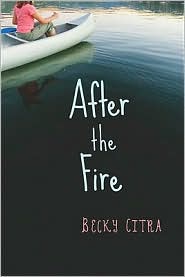
After the Fire Book Review


Author: Becky Citra. Release date: 2010. Publisher: Orca Book Publishers. ISBN: 9781554692460.

Annotation: Haunted by memories of the fire that destroyed her family’s trailer, Melissa’s life is changed forever when her mother, a recovering alcoholic, takes her and her brother, Cody, to stay at a remote lakeside cabin for the summer.

Personal thoughts: I was surprised by how much I enjoyed this novel. Melissa is an extremely realistic and honest main character, especially for a story written for ‘tweens. Her anger at her mother, Sharlene, is very real, and many readers will, unfortunately, be able to identify with the situations Melissa experiences. After the Fire touches on some very advanced topics, but does so in a way that makes them appropriate for young readers. The novel definitely creates some talking points between parents/teachers and ‘tweens about alcoholism, neglect, death and family relationships. I would recommend this novel for readers interested in a realistic story.


Plot summary: Eleven-year-old Melissa lives with her mother, Sharlene, and her four-year-old brother, Cody, in a cramped apartment. Melissa doesn’t trust Sharlene, a recovering alcoholic, and is haunted by memories of a terrible fire that destroyed the trailer her family shared with Sharlene’s former live-in boyfriend, Darren. When a family friend offers Sharlene a lakeshore cabin to stay in for the summer, Melissa is skeptical. Sharlene, Melissa and Cody travel to the remote location; Melissa is annoyed by her mother’s enthusiasm for the woods, the cabin, and the canoe she assures Melissa she will love paddling around the lake. Shortly after arriving, Melissa meets Alice, a girl her age, while exploring the island in the middle of the lake. Alice seems strange, but Melissa finds the fantasy world she creates to be interesting. As she spends more time with her mother and makes her first true friend in Alice, Melissa learns that holding onto her anger might not be worth the effort. And, as she learns more about Alice, Melissa wonders if perfect families exist only in fairy tales.


Review: This surprisingly poignant novel provides an utterly realistic look into the life of a girl who, through tragedy and hardship, lost the innocence of childhood too early. The fragile relationship between Melissa and her mother, Sharlene, is at times heartbreaking. Sharlene desperately tries to make up for past wrongs, and Melissa resists her at every turn. Their time at Flycatcher Lake, despite Melissa’s annoyance at having to spend her summer in a remote cabin, proves to be a therapeutic experience that brings the little family closer together. The character of Alice is also quite interesting. It is clear from the beginning that something is not quite right with the unusual girl. The descriptions of her family appear too perfect, and Melissa catches her in some lies early in their relationship. When Melissa discovers that Alice’s life is even less ideal than her own, it presents a lesson not only for her, but for the reader, that the “grass is always greener” notion, in reality, never pans out. This is just one of the reasons why After the Fire is a wonderful novel for young readers. Although it covers some sophisticated topics, alcoholism, neglect, death, Citra does an excellent job of making the story appropriate for younger readers. A very thought-provoking book for ‘tweens.
 
Genre: Fiction/Drama
 
Reading level: Grade 6+
 
Similar titles: N/A

Themes: Family relationships, neglect, truth vs. fantasy, anger.
 
Awards/Reviews: Positive review from VOYA and Booklist.
 
Series Information: None  

Discussion Questions:
- Do you think Sharlene is a good mother? Why or why not?

- What does the title "After the Fire" mean to you?

- Why do you think Sharlene takes her children to spend the summer at Flycatcher Lake?

- What was your first impression of Alice?

- Why do you think Alice tells Melissa the stories she does?

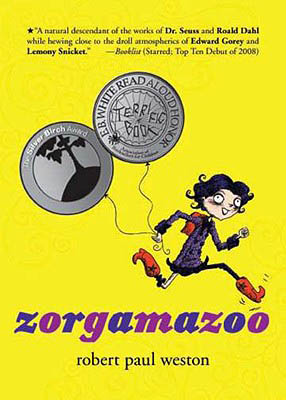
Zorgamazoo Book Review

Author: Robert Paul Weston. Release date: 2008. Publisher:  Penguin Group. ISBN: 9781595142955.


Annotation: Katrina Katrell happens upon Morty the Zorgle, and together they decide to uncover the fate of the missing Zorgles of Zorgamazoo. 


Personal thoughts: I had heard a great deal about this award-winning novel, and wasn’t disappointed in how clever and unique it is amongst recent literature for ‘tweens. Weston’s rhymes were simply amazing. While reading the book I couldn’t help but be constantly reminded of the work that must have gone into composing an entire novel, completely in rhyme. For me, the storyline played second fiddle to Weston’s literary craftsmanship. I did enjoy the novel quite a bit, and would definitely recommend it to ‘tweens as well as teachers seeking a fun read-aloud.
Plot summary: Katrina Katrell lives with a distant relative, Mrs. Krabone, who doesn’t understand why the young girl is constantly daydreaming about adventures and mythical creatures. One day when Katrina and Mrs. Krabone are on the subway, Katrina is sure she sees a large, hairy creature wearing a tie and walking around the underground tunnels. Mrs. Krabone is finally fed up, and contacts Doctor LeFang to “cure” Katrina with his horrible Cranial Puncturing Mincer of Mind. Katrina catches wind of the plan, and manages to escape. By chance, she meets up with Morty, a Zorgle, and the very same creature she spotted earlier on the subway. It appears that Morty has been given a quest to find out what happened to the Zorgles of Zorgamazoo, an underground country village where the inhabitants have vanished. Morty is quite timid, but his new friend, Katrina, convinces him to proceed on what she’s sure will be a grand adventure for them both.
Review:  Told entirely in rhyming couplets, Zorgamazoo is a creative and entertaining story for readers of all ages. Perhaps the most amazing thing about Weston’s rhymes is that they never grow stale or seem forced. He does have to employ some made-up words (a nod to Dr. Seuss), but, in general, he manages to rhyme ordinary phrases that ‘tweens will be able to understand. The plot of the novel is also very clever, with nods to influential authors like Roald Dahl and Lemony Snicket, but in an original package. Younger readers might be frightened by Mrs. Krabone and Doctor LeFang, who want to lobotomize Katrina. Some of the illustrations in the book, such as those of the Octomabots, a machine that is a cross between a bee and an octopus, and of Doctor LeFang’s Cranial Puncturing Mincer of Mind, might be frightening as well. Other aspects of the plot, however, like Winnie the Windingo who constantly cries, and an ogre who is extremely attached to his glass eye, will lighten the mood. Overall, Zorgamazoo is a fun novel for readers who are interested in something a little bit different. It would also make  a great read-aloud for a classroom or group of children or ‘tweens.
Genre: Fiction/Fantasy
Reading level: Grade 3+
Similar titles:  James and the Giant Peach by Roald Dahl, A Series of Unfortunate Events series by Lemony Snicket, any title by Dr. Seuss.
Themes: Bravery, adventure, the importance of imagination.
Awards/Reviews: Positive reviews from School Library Journal, Booklist, Kirkus Reviews, and The Horn Book Magazine. Recipient of 2009 E.B. White Honor Book award, Silver Book Award, nominee for California Young Reader Medal.   
Series Information:  None
Discussion Questions:
- This novel is written entirely in rhyme. Do you enjoy this style of writing? Why or why not?
- Why do you think Mrs. Krabone wants to keep Katrina from being imaginative?
- Do you think Morty is brave? Why or why not?
- What do you think the characters of Zorgamazoo look like? Draw some of your favorites.
- Does this story have a moral? What do you think the moral is?


Coraline Book Review

Author: Neil Gaiman. Illustrator: Dave McKean. Release date: 2002. Publisher:  HarperCollins Children’s Books. ISBN: 9780380977789.


Annotation: Coraline Jones lives in humdrum life in an old Victorian mansion apartment with her parents. One day, however, she discovers a passageway leading to another world where everything is better than her own…or is it?


Personal thoughts: As a big fan of the movie, I was really interested in reading the book version of Coraline. I was not disappointed! Like the film, the story is just eerie enough to be enjoyable. I really enjoyed the drawings by Dave Mckean that accompanied the text. They added an element of creepiness to the story, even though I had visions of the film while reading it. I would highly recommend this novel to ‘tweens searching for something fun to read under the covers at night. An instant classic.
Plot summary: Coraline Jones isn’t thrilled when her parents move her into an apartment in an old Victorian house. Her neighbors, two elderly women named Miss Spink and Miss Forcible, and an eccentric old man, Mr. Bobo, don’t help her to feel at home either. Coraline’s parents don’t pay her much attention, so she spends most of her time exploring the creepy old house. One day, she discovers a small door in the wall that has been bricked up. Despite warnings from her neighbors that she is in danger, Coraline decides to explore the door further when she is alone. She soon discovers that the bricks are gone, and instead, a passageway is on the other side of the door leading to an apartment that is identical to her own. Living in the other apartment are her Other Mother and Other Father, also identical copies of her own parents but with buttons for eyes. Coraline learns that this Other World is far more interesting than her own, and spends more and more time there, becoming closer with her Other Mother and Other Father. One day, her Other Mother offers to let Coraline live in the Other World forever. Coraline considers the idea, until she learns that in order to stay she will have to have buttons sewn on her eyes. Coraline quickly escapes the Other World, only to discover that her real parents are missing. Has her Other Mother trapped them in the Other World?
Review: This novel, adapted into the hit 3D film of the same title, is a truly creepy but engrossing story that will spook even the bravest of young readers. Almost from the beginning of the story, it’s clear that something unearthly is in store for Coraline. The house she’s moved to is creepy, and when she discovers the Other World, things get even more suspicious. Although the Other World is, at first, delightful, something isn’t quite right. Why do her Other Mother and Other Father have buttons for eyes? Why does the Other Mother seem so urgent to have Coraline agree to live in the Other World forever? After Coraline’s parents are kidnapped and she must rescue them, things get even creepier. Several scenes when the Other World is beginning to unravel into the horrifying place it is are truly eerie, even for adult readers. ‘Tweens will delight in the scariness of Coraline’s predicament, however, particularly since it does turn out well in the end. Gaiman does a truly remarkable job of creating an unusual and entertaining story for all ages to enjoy. Coraline is likely to be a classic for years to come.
Genre: Fiction/Horror
Reading level: Grade 4+
Similar titles:  Coraline the graphic novel, illustrated by P. Craig Russell.
Themes: Bravery/overcoming fears, taking family for granted, “the grass is always greener” concept.
Awards/Reviews: Positive reviews from School Library Journal, Booklist, Kirkus Reviews, and Publishers Weekly. Winner of Hugo Award for Best Novella (2003), Nebula Award for Best Novella (2003), Bram Stoker Award for Best Work for Young Readers (2002).  
Series Information: Film adaptation – Coraline (2009)

Discussion Questions:

- Have you ever wished you could live a different life? What about Coraline's life made her want to spend time with the Other Mother?
- Did you like Dave McKean's illustrations? Do you think they added to the story?
- Have you seen the film version of "Coraline"? If you have, what is different about the book? Which do you like better?
- Did you find this book to be creepy? Scary?
- Explain the concept behind the statement, "the grass is always greener on the other side of the fence." How does that relate to this book?

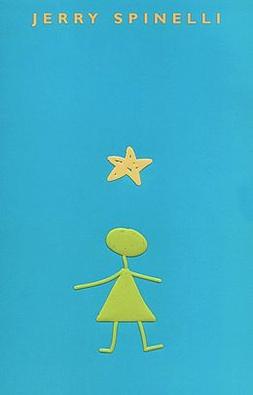
Stargirl Book Review

Author: Jerry Spinelli. Release date: 2000. Publisher:  Dell Laurel-Leaf. ISBN: 9780440416777.


File:Jerry Spinelli - Stargirl.jpgAnnotation: Mica High School is just like any other school until Stargirl moves to town. Stargirl doesn’t act like everyone else: she is free-spirited, perpetually optimistic, and constantly encouraging. Will the students of Mica High force her to conform?


Personal thoughts: I wasn’t sure what to make of this novel initially, but came to find the character of Stargirl to be quite endearing. She is unlike any other character I’ve met in a novel, and I realized that that was likely Spinelli’s intention. I really liked the relationship between Leo and Stargirl, and how he really admired her despite the pressure he felt from his classmates to shun her. I would definitely recommend this novel to ‘tween, teen and adult readers.
Plot summary: Sixteen-year-old Leo Borlock is a junior at Mica High School. He leads a normal life, along with the rest of his classmates who try not to stand out. Everything changes when new-girl, Stargirl Caraway, arrives at Mica High. Stargirl does everything but fit in. She wears unusual clothes (her mother is a costume designer), she carries her pet rat, Cinnamon, with her everywhere, and generally dances to the beat of her own drum. At first the rest of the school isn’t sure what to make of the newcomer, but soon the student body is enchanted by her charm, none more-so than Leo. Just as quickly as her popularity rises, however, it begins to fade when Mica High begins to question the things she does. They don’t understand why she insists upon cheering when rival basketball teams score, why she shows up to the funerals of strangers, or any of her formerly charming actions. Leo’s still madly in love with Stargirl, even if the rest of the school starts to shun them both. But how long will his infatuation last as Mica High School becomes more and more distant?
Review: Stargirl is an interesting and unique story about an interesting and unique, free-spirited girl. Spinelli does an excellent job of setting the stage for Stargirl’s “grand entrance” to Mica High School; it’s akin to when Dorothy steps into the Land of Oz for the first time and everything goes from black-and-white to color. The relationship between Leo and Stargirl is an interesting mix of adoration and confusion. Leo doesn’t know what to make of Stargirl’s strange behavior: her ukulele playing, her unusual clothes, her celebration of all the little things her classmates do. Young readers will be able to appreciate how different Stargirl is from their own peers, just as Leo does. Her rise and fall from popularity will also be interesting for ‘tweens who might witness similar situation in their own schools. Overall, Stargirl’s unique and fun-loving qualities make for an entertaining and heartwarming story that will likely stick with readers for some time.
Genre: Fiction
Reading level: Grade 5+
Similar titles:  Love, Stargirl by Jerry Spinelli (sequel to Stargirl).
Themes: Conformity/nonconformity, high school relationships, acceptance, struggling to fit-in.  
Awards/Reviews: Positive reviews from School Library Journal, Kirkus Reviews, and Publishers Weekly. An ALA Top Ten Best Book for Young Adults.
Series Information: Sequel, Love, Stargirl, by Jerry Spinelli.

Discussion Questions:

- What does the word "conformity" mean to you? Does that concept play an important role in the novel?

- Have you ever known anyone like Stargirl? Would you like to be like Stargirl yourself? Why or why not?

- Why do you think Stargirl becomes popular so quickly? Why do you think she becomes unpopular so quickly?

- Who is your favorite character in the novel? Why?


Gilda Joyce: Psychic Investigator Book Review

Author: Jennifer Allison. Release date: 2006. Publisher: Puffin. ISBN: 9780142406984.


Annotation: Self-proclaimed “psychic investigator,” thirteen-year-old Gilda Joyce decides to visit her long lost uncle and his daughter in San Francisco. When she arrives, Gilda discovers an intriguing secret: her relative’s mansion is haunted!


Personal thoughts: I was surprised by how engrossing I found this novel. I was immediately aware of the underlying elements of the story, Gilda’s sadness over her father’s death, her strained family situation with her overworked mother and distant brother, and the coldness between Mr. Splinter and Juliet. The family relationships were quite heartbreaking at times. Allison does a wonderful job, however, of lightening the mood with Gilda’s antics. Gilda is a very likable heroine and the mystery she and Juliet solve is actually quite interesting. I found myself feeling “creeped out” at times from the antics of the ghost of Aunt Melanie. Overall, this is a very enjoyable novel both for adults and tweens.
Plot summary: Gilda Joyce lives a life of glamour and intrigue in Detroit, Michigan. At least she imagines she does. As a self-described “psychic investigator,” Gilda strives to use her natural abilities to solve mysteries of the paranormal, among her many other projects. When her eight-grade year ends, Gilda is worried her summer won’t be as exciting as she’d hoped after her best friend goes away to camp. Determined  to have an adventure, Gilda contacts a distant relative, Mr. Splinter, in San Francisco and invites herself to stay for the summer. After a mis-communication with Mr. Splinter’s ditzy assistant, Gilda is actually asked to come keep Mr. Splinter’s daughter, Juliet, company over the summer. Gilda arrives in San Francisco and soon discovers that the Splinters are living in a house haunted by the ghost of Mr. Splinter’s sister, Melanie, who committed suicide years before. Gilda and Juliet become friends, and are determined to solve the mystery of Melanie’s death. What will Gilda’s psychic investigations uncover?
Review: This fun and clever novel not only delivers an entertaining and sometimes spooky storyline, but also a message that won’t be lost on young readers. Gilda Joyce makes for an interesting and somewhat complex heroine. She is confident, blunt and clever, but there is a layer of sadness over the death of her father two years earlier. Throughout Gilda’s bumbling psychic investigating, it’s clear that she is using the mysteries as a means of working through his death. Juliet, Mr. Splinter’s anti-social, sickly daughter, is also an interesting character for young readers. At the outset of the novel, Juliet is contemplating suicide, and she is obviously wrestling with some inner turmoil of her own. The relationship between Gilda, Juliet and Mr. Splinter is very interesting, and is reminiscent of Mary, Colin and Mr. Craven in Burnett’s The Secret Garden. Gilda’s adventures are merely a vehicle for what is actually a very relevant and touching story about families, communication and friendship.  
Genre: Fiction/ Mystery
Reading level: Grade 5+
Similar titles: Harriet the Spy by Louise Fitzhugh, The Secret Garden by Frances Hodgson Burnett, the Nancy Drew series by Carolyn Keene.
Themes: Death, grief, family, communication, friendship.
Awards/Reviews: Positive reviews from School Library Journal and Booklist.
Series Information: Part of Jennifer Allison’s Gilda Joyce series.
Discussion Questions:
- Why do you think Gilda wants to be a psychic investigator?
- Do you think her father's death plays a role in why she wants to be a psychic investigator?
- Do you think Mr. Splinter and Juliet have a good relationship? Why or why not?
- Do you think Gilda's presence in their house makes the relationship between Mr. Splinter and Juliet better or worse?
- Do you think Juliet is really being haunted by the ghost of her Aunt Melanie? Why or why not?